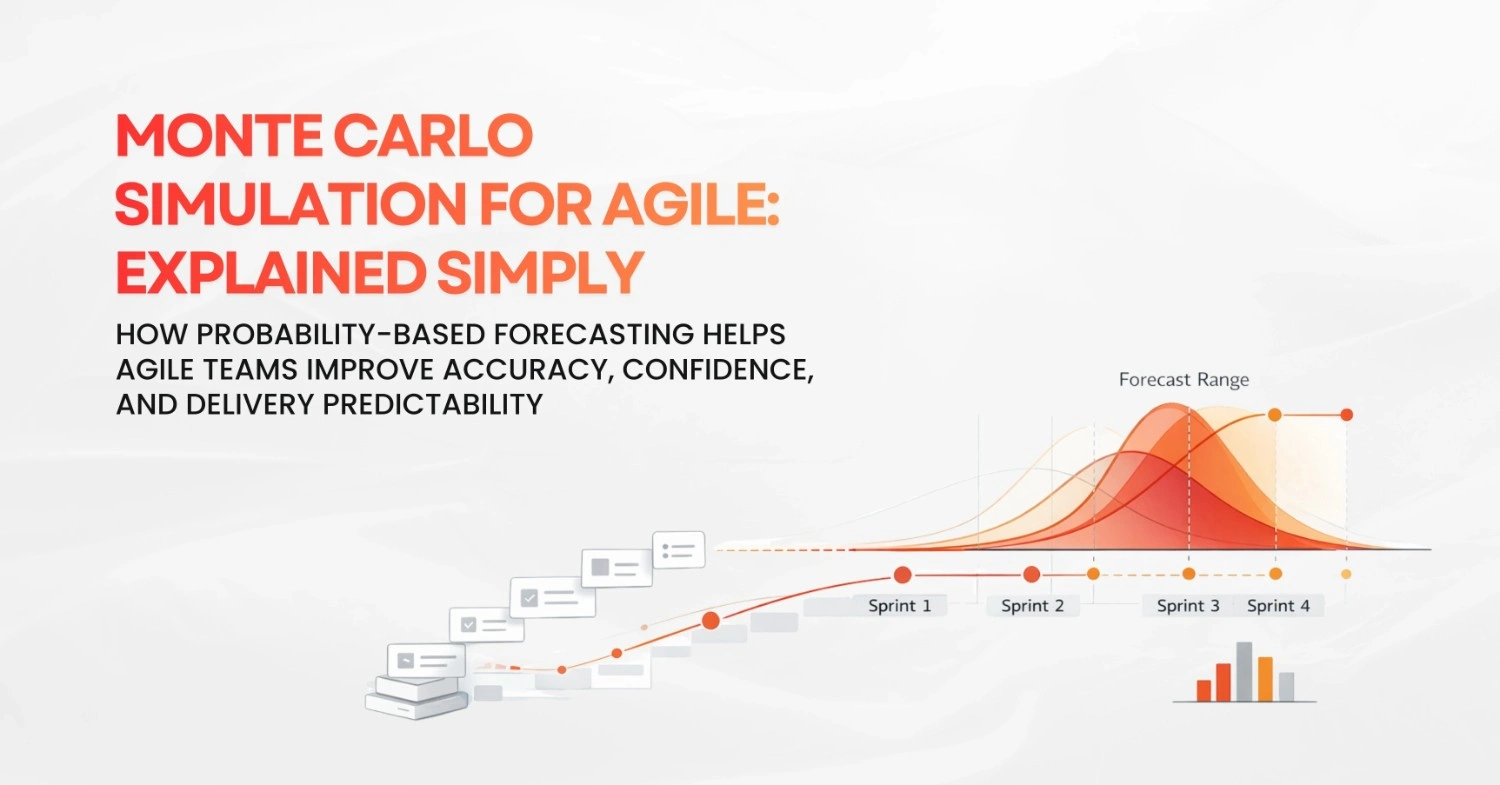
Monte Carlo Simulation in Agile is becoming one of the most reliable forecasting techniques for modern Agile teams. Although the Agile methodologies have a lot of focus on adaptability and developing things incrementally, many teams continue to have difficulty accurately forecasting delivery dates.
In general, most of the traditional forecasting techniques used for agile delivery rely on theory, static estimates, or some degree of wishful thinking. Therefore, its common for teams to miss delivery dates or to struggle with delivering an accurate estimate to stakeholders regarding delivery.
Monte Carlo simulation was once thought to be a highly complicated mathematical method of forecasting but can now be practically utilized as a forecasting tool by Agile delivery teams, of any size, to achieve improved accuracy in forecasting and greater predictability for delivery.
Why Traditional Agile Forecasting Often Fails
Agile methodologies have flexibility but estimating how long to complete tasks with Agile delivery continues to be one of the toughest problems for teams using Agile methods.
A few of the core forecasting techniques include:
Story Point Estimation
Planning Poker
Expert Judgement
Velocity Based Forecasting
Each of the above-mentioned techniques allow the teams to collaborate as they go through their planning activities; however, these techniques rely on speculative assumptions regarding the future rather than actual data.
There are a few reasons why estimation in a traditional manner is often unreliable, such as:
Optimism Bias When Estimating
Team Availability Changes
Unanticipated Production Issues
Sprint Velocities Change
Due to the above uncertainties, it becomes increasingly difficult to predict the delivery timeframes of work. Missing deadlines or constantly changing your release schedules will make it more challenging for your Stakeholders to have confidence in the products that your team is delivering.
By utilizing the Monte Carlo Simulation process, timelines can be created based on actual historical performance instead of speculative assumptions.
What Is Monte Carlo Simulation in Agile?
Monte Carlo simulation is a probabilistic forecasting method that uses historical sprint data to generate thousands of possible delivery scenarios.
Rather than establish one specific delivery date based upon a guess, it calculates several possible delivery dates (with varying confidence levels). For example, rather than making the following statement: 'Delivery will take place in 4 sprints', an Agile team can instead make these statements:
70% chance of completion in 4 sprints
85% chance of completion in 5 sprints
95% chance of completion in 6 sprints
This method allows teams to realistically convey their expectations regarding delivery. Monte Carlo Simulation helps Agile teams visualize uncertainty, thereby allowing them to make better planning choices and support their stakeholders in establishing reasonable expectations.
Key Benefits of Monte Carlo Simulation in Agile
Agile Forecasting Utilizes Monte Carlo Simulation
Monte Carlo simulation provides multiple benefits when using Agile Forecasting.
Forecasts By Mean Historical Performance
Forecasts are based upon historical performance rather than made using either 'Intuition' or 'Assumptions'.
Complete Visibility of Risk
Teams can view many different potential outcomes as opposed to one estimate.
Communication to Stakeholders
Using probability as a timeline provides a way for stakeholders to gain improved insight into the risk of delivery.
Planning Sprints and Releases
Commitments can be made using realistic expectations rather than purely optimistic predictions.
Increasing Forecast Accuracy
The reliability of Monte Carlo Simulation increases as additional throughput data becomes available.
How Baseliner.ai Simplifies Monte Carlo Forecasting
Baseliner.ai helps Agile teams apply Monte Carlo forecasting without manual spreadsheets or complex statistical analysis.
The platform automates data collection and forecasting using historical sprint performance. Key capabilities include:
Automated throughput data imports from project management tools
One-click probability-based delivery forecasts
Real-time updates as new sprint data becomes available
Visual dashboards showing probability curves and delivery likelihood
Forecasting support across multiple teams and enterprise-level projects
By automating Monte Carlo simulations, Baseliner.ai allows teams to focus on planning and delivery rather than data analysis.
Conclusion
Using Monte Carlo Simulation in an Agile environment allows for improved accuracy when making forecasts, increasing the ability for organizations to consistently deliver products as expected.
The use of historical data for Agile project management with Monte Carlo simulation produces more accurate forecasts based on probability. This leads to greater transparency in the planning process, which provides stakeholders with an understanding of the risk related to the delivery of the final product.
By utilizing Monte Carlo simulations in their standard operating procedures, organizations can turn project forecasting from an exercise of guesswork into a strategy of data-driven planning.
FAQs
Q1. What is Monte Carlo simulation in Agile forecasting?
Monte Carlo simulation in Agile forecasting is a probabilistic method that uses historical sprint or throughput data to simulate thousands of possible delivery scenarios. It helps teams estimate completion timelines using confidence levels instead of relying on a single fixed date.
Q2. Why do Agile teams use Monte Carlo simulation for delivery prediction?
Agile teams use Monte Carlo simulation because it accounts for variability in team performance and delivery patterns. By analyzing historical data, it provides more realistic forecasts and improves delivery predictability.
Q3. What data is required to run Monte Carlo simulation in Agile?
The primary data required is historical throughput, which represents the number of work items completed during previous sprints. This data allows simulations to generate realistic probability-based forecasts.
Q4. How accurate is Monte Carlo simulation for Agile forecasting?
Monte Carlo simulation can significantly improve forecasting accuracy because it uses historical performance data and thousands of simulations to estimate outcomes. Accuracy improves over time as more sprint data becomes available.
Q5. Can Monte Carlo simulation work for small Agile teams?
Yes. Monte Carlo simulation works for Agile teams of any size. Even small teams can use their historical sprint data to generate probability-based delivery forecasts and improve planning decisions.