Introduction
Agile practices have guided project managers since the Agile Manifesto in 2001. Over the years, Agile has helped project managers and teams have speedy reactions, ultra-quick delivery, and produced cooperation and collaboration through change.
If you’re a project manager, you know the struggles Agile brings: backlogs that balloon, sprints that promise so much and deliver so little, and risk that doesn’t show itself until it’s too late! Enter Generative AI, a hard-hitting, measurable difference, instead of a “pie-in-the-sky” experiment. Generative AI technologies are already delivering worthwhile gains in productivity. Research shows that AI adoption can drive team productivity up to 40% (Accenture), and cut error and rework by up to 50% (McKinsey). Stop to think about that for a moment - even though AI technologies are young, they are quickly being incorporated into agile workflows by 2025, from being a simple “nice-to-have” tool, to a valuable core component of work requirements. Let's break down how Project Managers can harness Generative AI to improve the world of Agile delivery, with facts and evidence that show how much of an impact Generative AI can make!
1. Sprint Planning
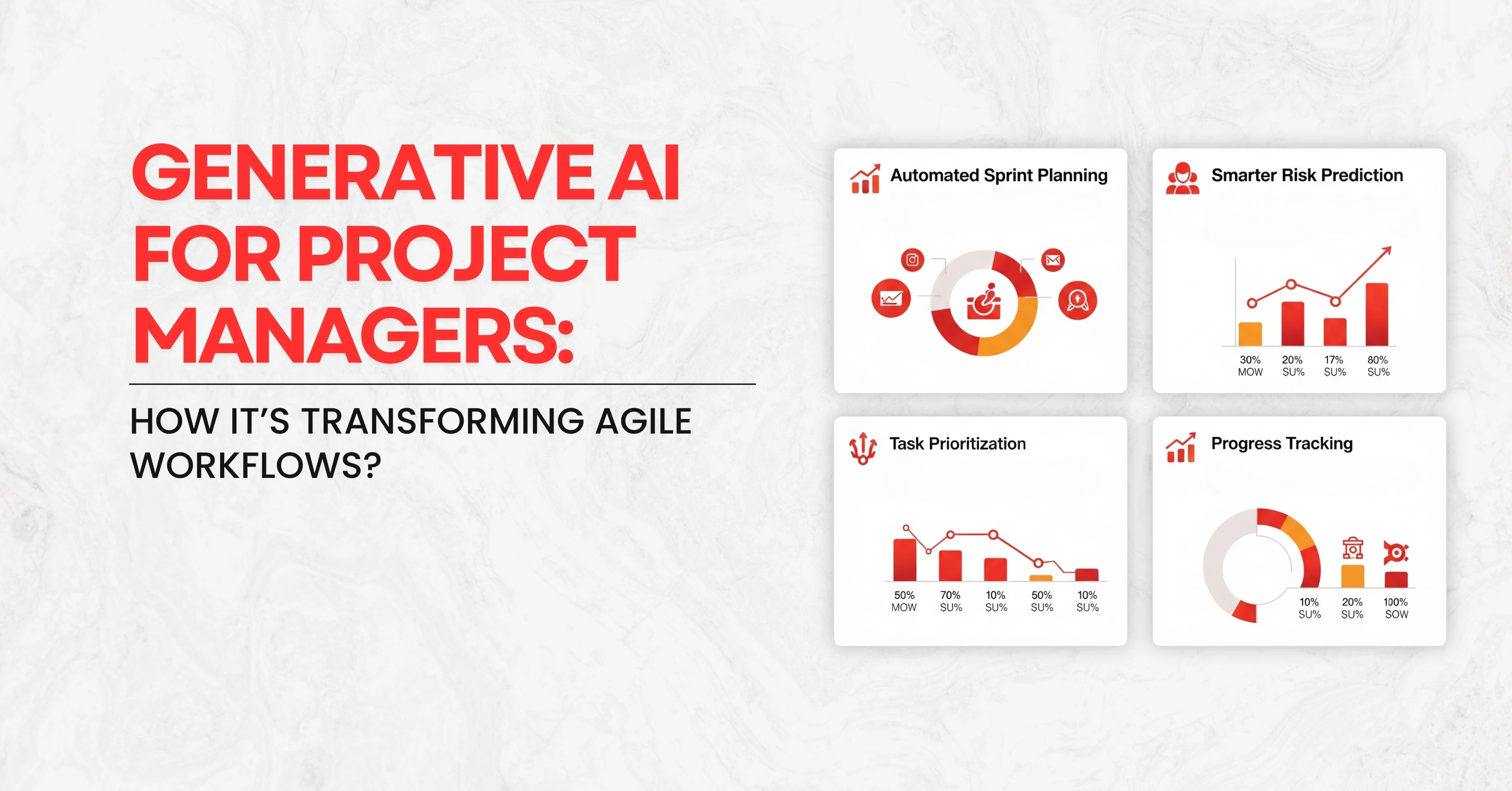
Sprint planning has always been about finding the right balance - that is, pushing teams to accomplish more without tipping the scale toward burnout. As managers, we have relied on instinct or experience while estimating story points, which can lead to overcommitment and unrealistic delivery. The introduction of Artificial Intelligence transforms this entire process into a data driven approach making sprint planning a transparent, predictable process.
Research has indicated that deep learning models can forecast story points within 93% accuracy, this level of accuracy far exceeds our manual estimates. By examining not only the complexity of the tasks, but also historical context of delivery, AI will keep sprint goals high yet attainable. The overarching results will lead to less surprises within sprints and delivery will have a consistent, sustainable cadence.
From a managerial perspective, this represents a shift in sprint planning process from estimation to data-driven forecasting. Baseliner AI reflects this shift in practice, as project leaders can now leverage data-backed insights to bring clarity and predictability into how sprint planning occurs.
2. Backlog Management
If you talk to any project manager you’re probably going to get a sigh when you ask them about their backlog. When projects grow, backlogs tend to grow with them and often turn into thousands of items being jostled for attention. In a survey of project managers conducted by the Project Management Institute in 2019, one of the top three response categories was backlog prioritization as the challenge Agile managers face. That’s where Artificial Intelligence has a serious advantage.
AI can automatically rank the items looking at value, risk, and dependencies in order to keep the backlog lean and smarts on strategy. In point of fact, a report by the International Institute for Learning published in 2024, found that 41% of project management professionals who adopted AI-powered project management tools experienced significant improvements in project outcomes.
This improvement demonstrates a larger trend - in fact Markets and Markets reports that The AI in Project Management Market is expected to grow from USD 2.5 billion in 2023 to USD 5.7 billion by 2028, with a CAGR of 17.3%. Collectively, these findings point to not just the increased adoption of AI in project management, but the measurable changes it is having on how projects are planned, monitored and delivered
3. Predictive Risk Management
Even the most Agile practitioner will be confronted with risks at the worst possible times – pushed dependencies, runaway workloads, or depleted resources. The challenge is that most managers do not see those risks until they are breaking the flow. Generative AI changes the game.
New research highlights the differential impact of AI on effectiveness in project management. For example, one study done with BCG consultants, Harvard Business School, and MIT, revealed that less experienced practitioners are 43% more effective when supported by AI and more experienced consultants are 17% more effective. This illustrates how AI serves as both a gear-shifter for learning for new professionals by speeding their upskilling process while still providing some incremental boost to seasoned veterans. And this is not just about preventing failure - it enables teams to make informed and proactive decisions.
They can effectively reallocate resources or re-prioritize before they experience a set-back. Solutions like Baseliner AI put this into practice by converting historical project signals into predictive information, enabled project leaders to visualize risks before they rise, and bolster resilience into their Teams sprints.
Read Our Other Blogs: How Agile Teams Track Project Progress
4. Meetings That Drive Action
In the world of agile software development, meetings are integral, whether stand-ups, retrospectives, or sprint reviews. But too often, all those conversations lead to little to no follow-up. Notes are misfiled, action items are lost to the dust of time, and decisions simply go untracked. Enter the AI assistant.
According to Deloitte's report on the use of AI tools, collaboration improves by 33% using these tools, and documentation time can even decline by up to 50%. AI systems such as Zoom AI Companion or Notion AI now provide auto-summarization of meetings, which include highlighting of decisions made, pulling out the action items.
This means less wasted time on admin tasks and more time on doing. Meetings become what they were intended to be: short, sharp interventions for progress.
5. Continuous Learning
Retrospectives are the pulse of Agile improvement. The reality is, it is hard work to comb through months worth of notes to identify patterns, and as a result many teams skip that analysis entirely if they have that possibility.
AI solves this by looking at retrospective data over several sprints and identifying recurring issues such as scope creep or workloads that are not balanced. A pilot study by Deloitte found that My Assist was able to process 3.65 million queries and 20 billion words, saving up to 50% of time in documentation.
For leaders, this means retrospectives are no longer an event - they are an ongoing, data driven, improvement cycle.
6. Clearer Stakeholder Communication
One of the toughest parts of project management is invariably reporting. Reporting on status updates, dashboards, and simplifying technical details for stakeholders can take several hours of your week.
With AI, it is straightforward. A UK trial of Microsoft 365 Copilot with 14,500 users found project managers saved an average of 26 minutes a day from time-consuming tasks while entry-level users saved even more, 37 minutes.
Most importantly, 70 per cent of project managers reported that AI helped with time consuming, tedious tasks and 80 per cent wanted to make sure that they didn't work without it anymore. This could help give stakeholders clarity in real-time and help managers spend more time actually using their leadership skills than writing reports.
7. The Bigger Picture
AI isn't just an Agile assistant, it's a productivity machine across fields. The St. Louis Federal Reserve maintained that generative AI has saved employees 5.4% of weekly work time - or about 2.2 hours each week per worker. That comes out to an aggregate productivity increase of 1.1% across the economy! Focusing in software teams, a GitHub Copilot study reported developers completing work 55.8% faster with AI-enabled capability and Google internal trials reported 21% faster on more complex tasks.
These are not abstract numbers - they are indications the AI is eliminating unproductive hours and hitting delivery commitments at speeds that lead to better outcomes in measurable ways.
8. Adoption Trends
Even with the apparent advantages, uptake is still patchy: • Only 22% of project managers reported AI tools in use in their organizations.
- Only 12% reported widespread use, although among tech firms, that number rises to 34%.
- Simultaneously, 39% of leaders plan to adopt AI in the near future, and 82% of executives expect AI will significantly change the world of project management in the next five years (PMI). This gap demonstrates a simple fact: adopting sooner than later, is likely to put you ahead of the competition.
Final Thought
There is now overwhelming evidence that AI is not a fad. It is changing the way Agile teams are functioning. A 2024 research article published in MDPI Electronics entitled "Predicting Agile Sprint Outcomes with Machine Learning," reported a 93% accuracy in predicting sprint outcomes achieved by machine learning models based on metrics such as team capacity, team effectiveness, and project complexity. Similarly, research from MIT Sloan School of Management and Harvard Business School found that generative AI improves highly competent professionals' performance by almost 40%, as compared to those who do not leverage AI.
For project managers, this shift means AI is not just about automation but alleviating project managers from repetitive, reactive work and allowing them to spend more time on developing leadership, delivering value and pursuing strategy.
This is where platforms, like Baseliner AI, provide value. Baseliner was built specifically for Agile environments to help clarify projects by turning complex data into meaningful insights, enabling team’s to establish realistic sprint baselines, forecast with certainty, and ensure stakeholders are aligned. In essence, it is the reality of the potential for AI - enabling project managers to have peace of mind and meaning when they lead in a future where agility and intelligence can be intertwined.